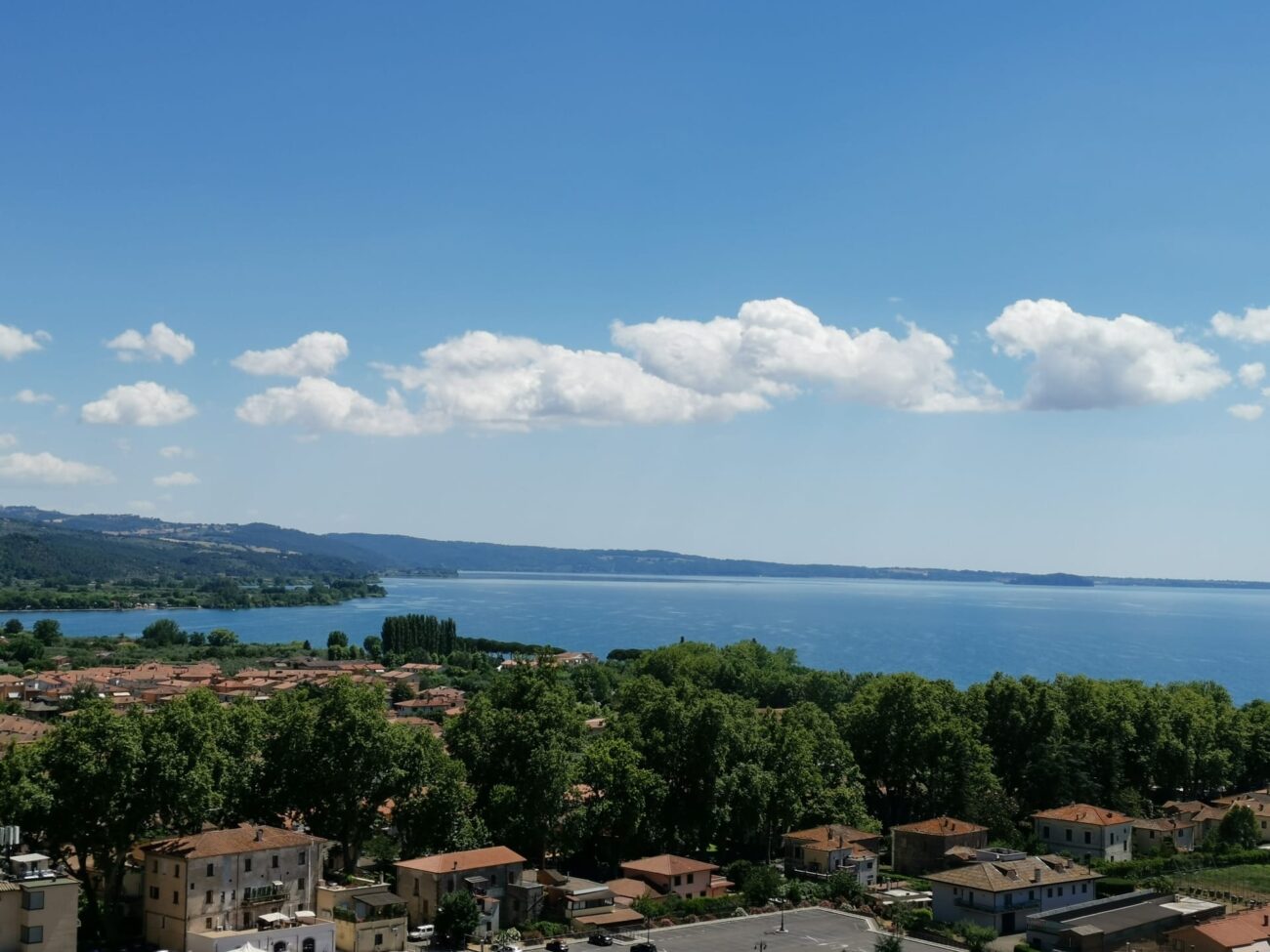
Palazzo del Drago
Built on multiple levels covering approximately half a hectare, it combines the characteristics of a fortress and a noble residence, with loggias, halls, panoramic terraces, and a park of over 2,500 square meters.
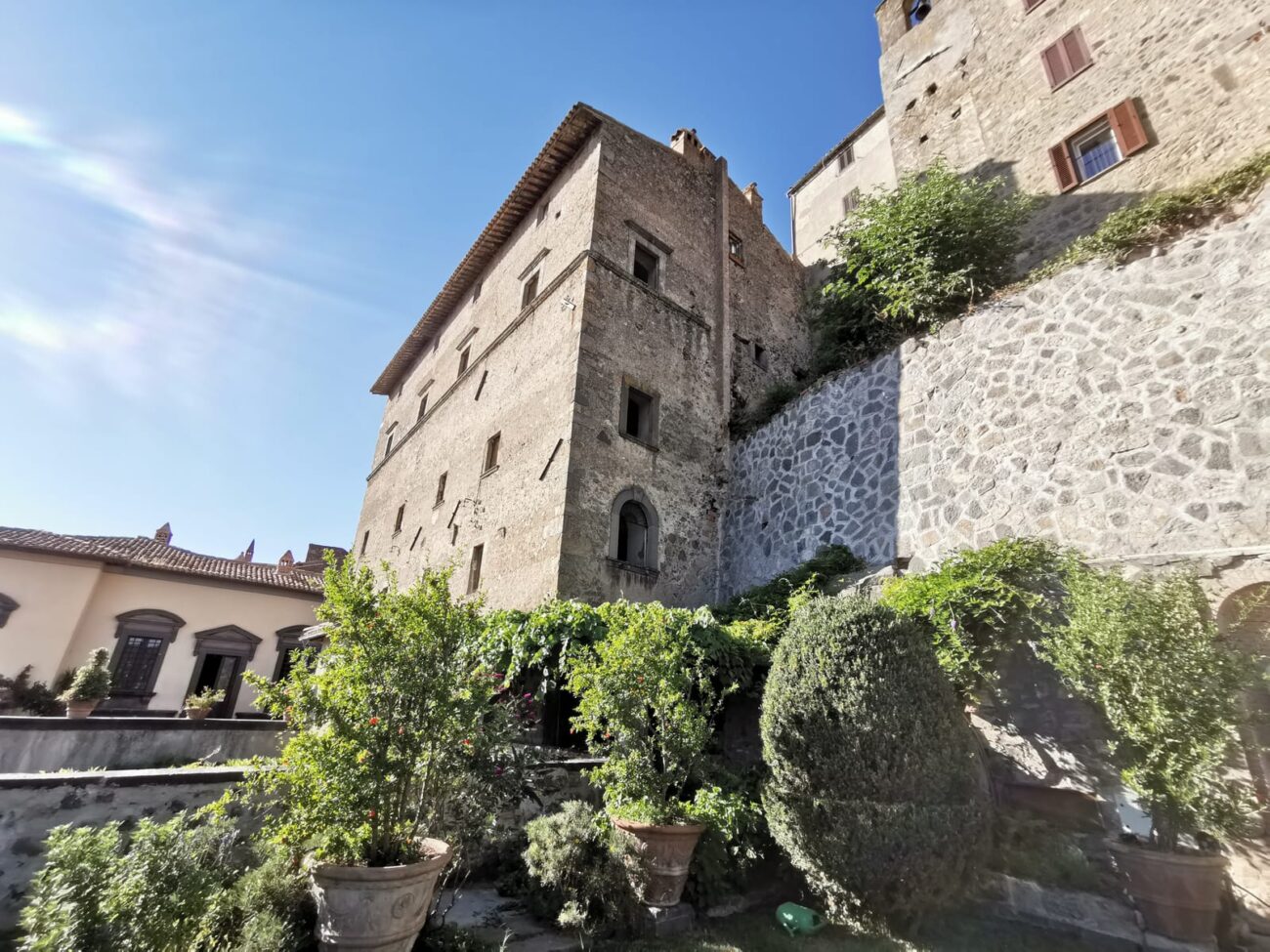
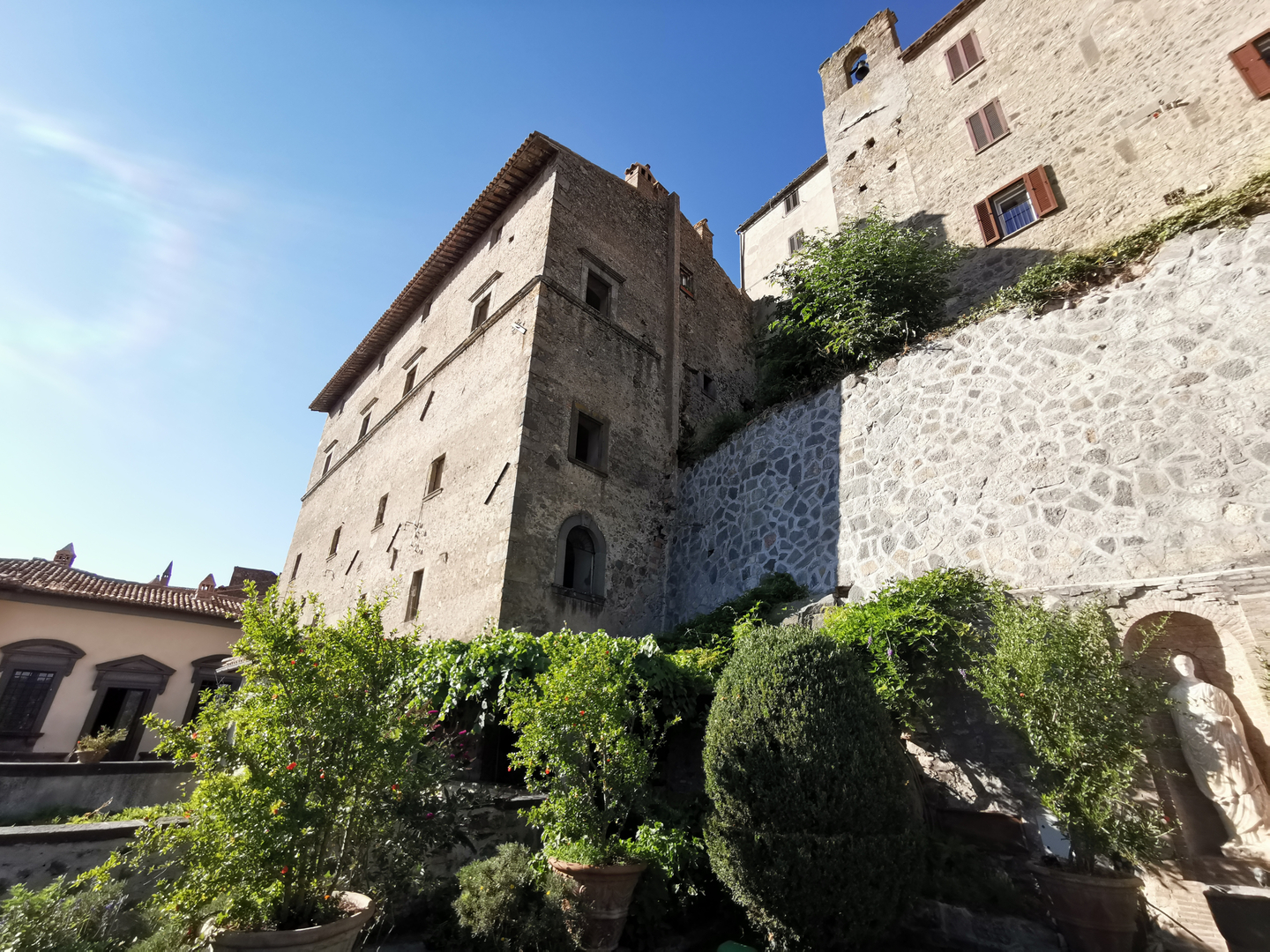
Palazzo del Drago, originally Palazzo Crispo, is an imposing and complex 16th-century architectural ensemble that occupies the steep northern area of the ancient village. It connects to the Rocca Monaldeschi through its varied system of ramps, vaults, and staircases.
It was built at the behest of Cardinal Tiberio Crispo (1498-1566), son of Giovanni Battista Crispo and Silvia Ruffina; the latter, who later became the mistress of Cardinal Alessandro Farnese, governor of Bolsena from 1525 to 1534 and later Pope Paul III, gave birth around 1500 to Costanza, of whom Tiberio was thus a half-brother.
The complex is the result of two construction phases (1533-1544 and 1554-1561), corresponding in part to the periods when Crispo held the position of governor of Bolsena. The southern part of the palace develops along the winding Via delle Piagge, crossing it via hanging rooms, while the northern part, visible from the garden, presents itself as a massive building with a severe appearance characterized by the Serlian loggia on the oblique wall facing the lake.
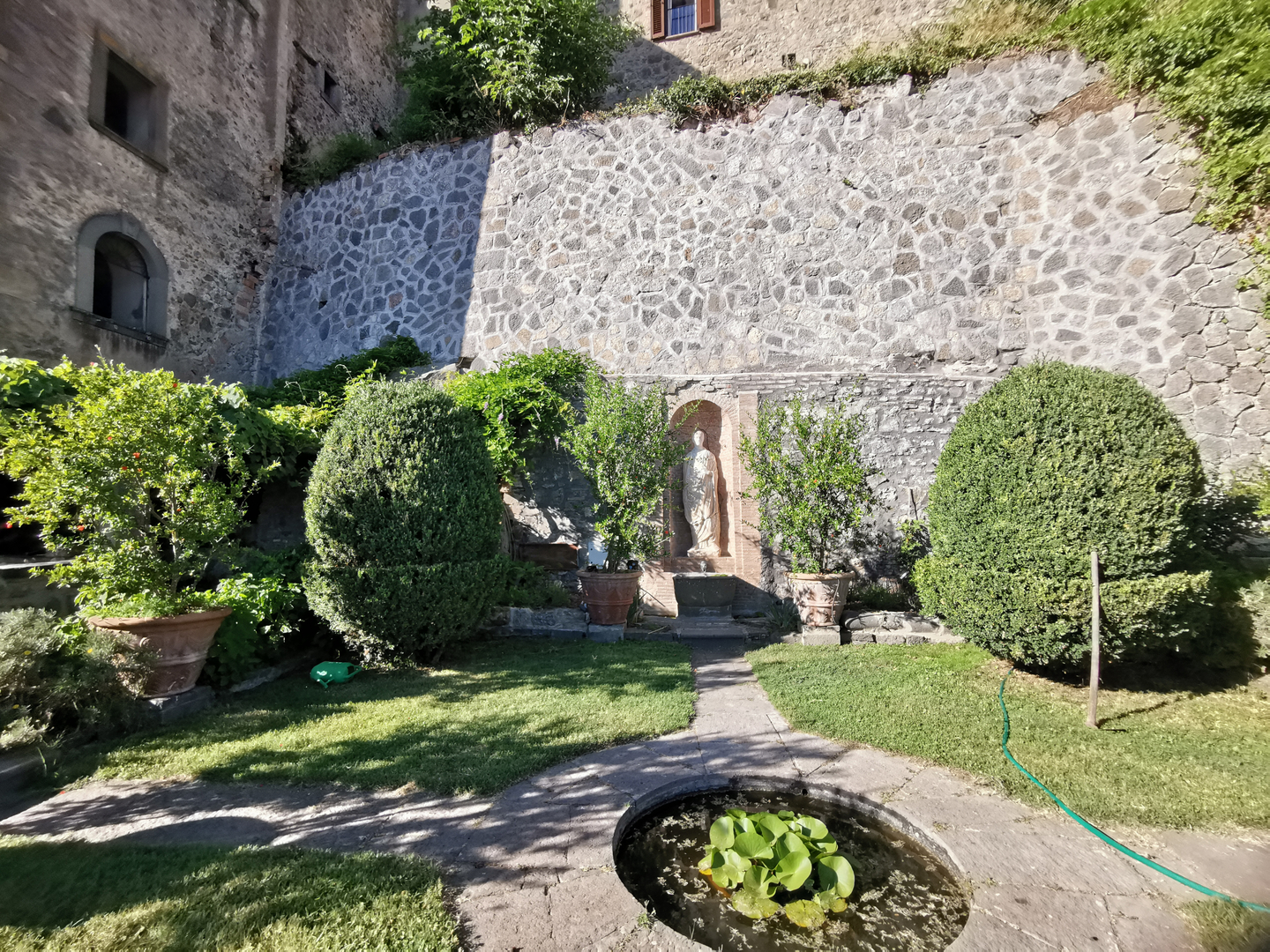
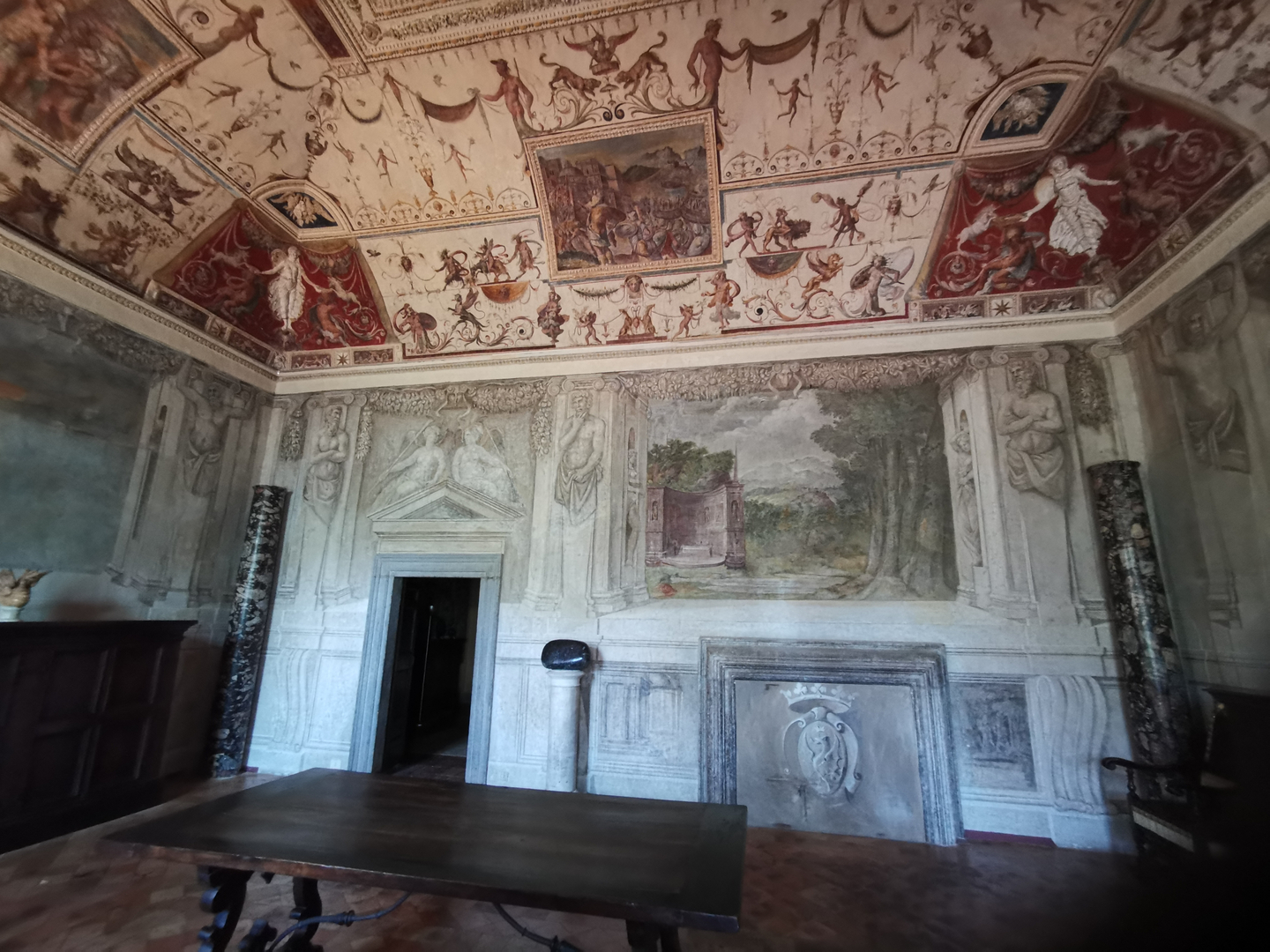
It extends over approximately half a hectare on several floors and levels and combines the characteristics of a fortress and a noble residence. Inside, the palace houses important frescoes including those by the renowned Bolognese Mannerist painter Prospero Fontana, frescoed loggias, halls, galleries, a chapel, a library, terraces with views toward Lake Bolsena, hanging gardens, and a 2,500 square meter park maintained with various types of plants, flowers, and vegetable gardens.
CONSTRUCTION PHASE 1533-1544
Crispo, appointed in 1535 as secret chamberlain to Farnese, who had by then become pope, purchased houses adjacent to his residence. He then became, in 1540, governor of Bolsena and gave impetus to the work on the new palace, entrusting it, thanks to his important connections, to the best artists and architects of the time such as Raffaello da Montelupo and Simone Mosca, both students of Antonio da Sangallo the Younger, who had to adapt the already existing buildings in search of functional connections between them. The construction of the palace, in fact, was not linear, not being a building erected from the foundations but the result of the various coordination of already existing buildings.
This first nucleus, defined by 1544, develops along Via della Piaggia, crossing it with hanging rooms, where the original entrance is located, from which rises the four-flight staircase, the beautiful staircase ascent mentioned by Giorgio Vasari in the “Life of Simone Mosca,” which leads to the hanging terrace, from where one accesses the Great Hall, already completed in 1542, destined for council sessions presided over by the governor of Bolsena: the representative function of the room is emphasized by the presence of the owner’s name inscribed on the architraves of doors and windows.
From the Great Hall one accesses the other rooms: the private rooms, the so-called Library which in turn connects the Pauline or Farnesian Loggia, with its beautiful coffered ceiling, with the Doctor’s Loggia, and the small private chapel with a central plan covered by a dome.
In 1540, Cardinal Crispo probably received Pope Paul III in the palace under construction, and he induced him to enrich it with the aforementioned Pauline or Farnesian Loggia, as Crispo himself recalls in a letter from the following year. This loggia, with a panoramic view of the lake, is located on the first floor of the palace and features a painted wooden ceiling according to a program of Farnesian celebration: in the center is the papal coat of arms and six medallions display the Farnese lily.
SECOND CONSTRUCTION PHASE 1554-1561
Again appointed governor of Bolsena in 1553, the following year Crispo set to work on the other wing of the palace, the “Torrazzo,” built in the area between the Porta di Castello Capite and the underlying Porta di S. Giovanni, designed by Tommaso di Giacomo Bevilacqua da Bissone, later replaced by Giulio Merisi da Caravaggio: for the construction, starting from 1559, red stone from the Poggio Restaldo quarry was used, diverted by the governor from a supply destined for public works. The palace was completed in 1561. The fresco and stucco decoration of numerous rooms located on the two floors of the Torrazzo was initiated starting from 1559 and was interrupted in 1562, when the people of Bolsena, dissatisfied with Crispo’s administration, had him removed from the position of governor. From this wing called the Torrazzo, a spiral staircase ends on the upper floor in the small “Serlian” loggia, with a triangular plan, overlooking the piazzale di San Giovanni below and with a wide view of the lake.
THE FRESCOED HALLS
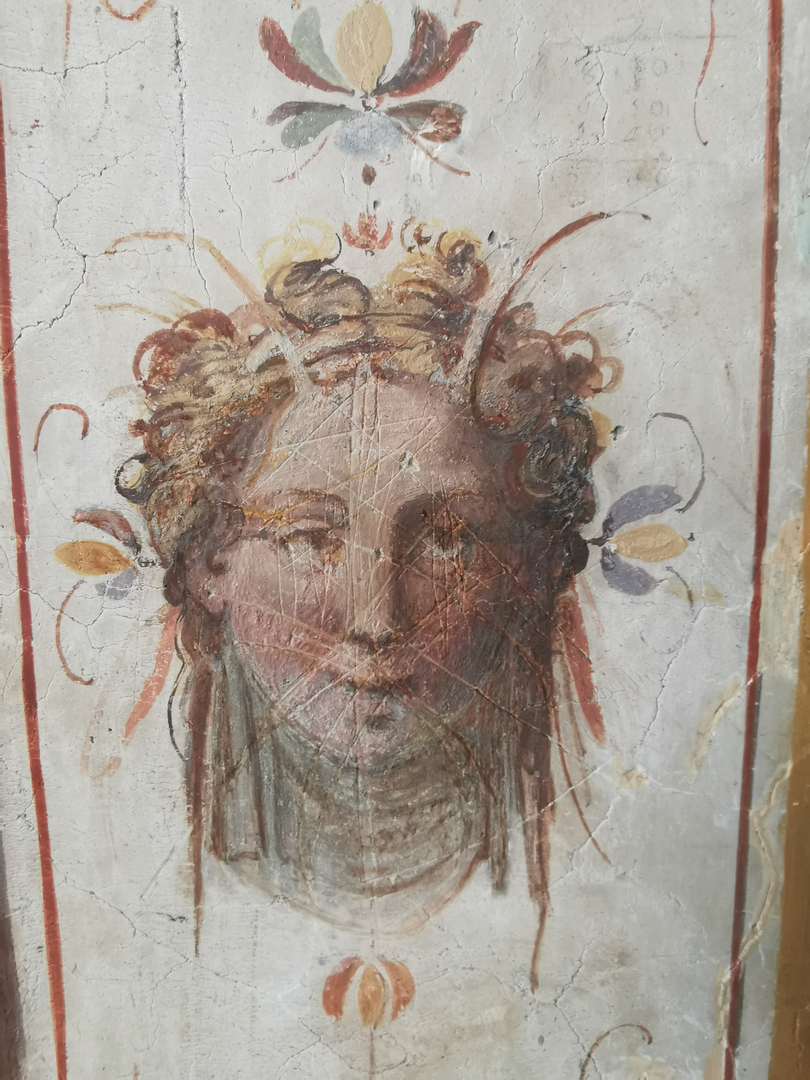
The execution of the frescoes in the halls of the first and second floors dates between 1559 and 1562; they are attributable to the hand and workshop of Prospero Fontana and inspired by the great cycles of Roman palaces including that of Castel Sant’Angelo where, between 1543 and 1545, Crispo himself, appointed castellan, had overseen the works, and by masters such as Pellegrino Tibaldi, Raffaellino del Colle, and Perin del Vaga.
FRESCOES OF THE HALL OF ALEXANDER THE GREAT
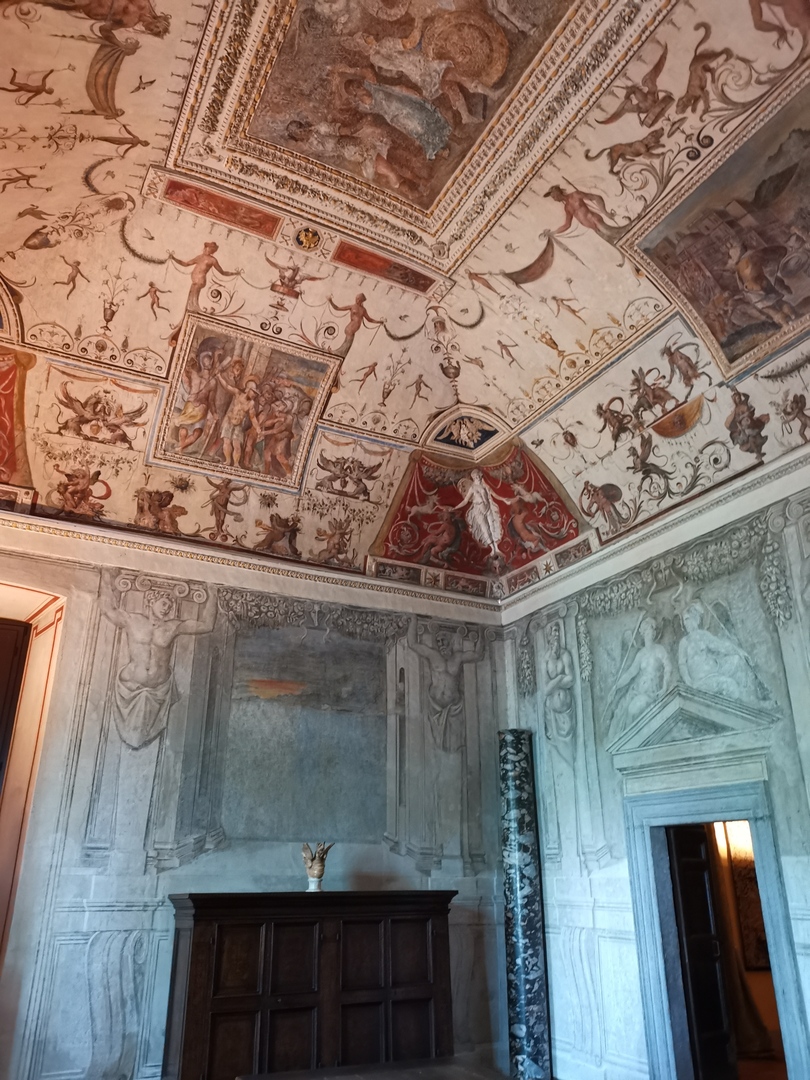
The hall located on the first floor and frescoed both on the walls and on the vault is called “of Alexander the Great” from the stories of the great commander depicted in the vault, with evident onomastic homage to Pope Paul III, born Alessandro Farnese. The hall suffered serious damage during the Napoleonic invasion and part of the decoration has deteriorated. At the corners of the vault are painted grotesque motifs with the emblem of Tiberio Crispo and his Farnese protectors.
HALL OF THE BACCHANAL OR “OF THE PUTTI”
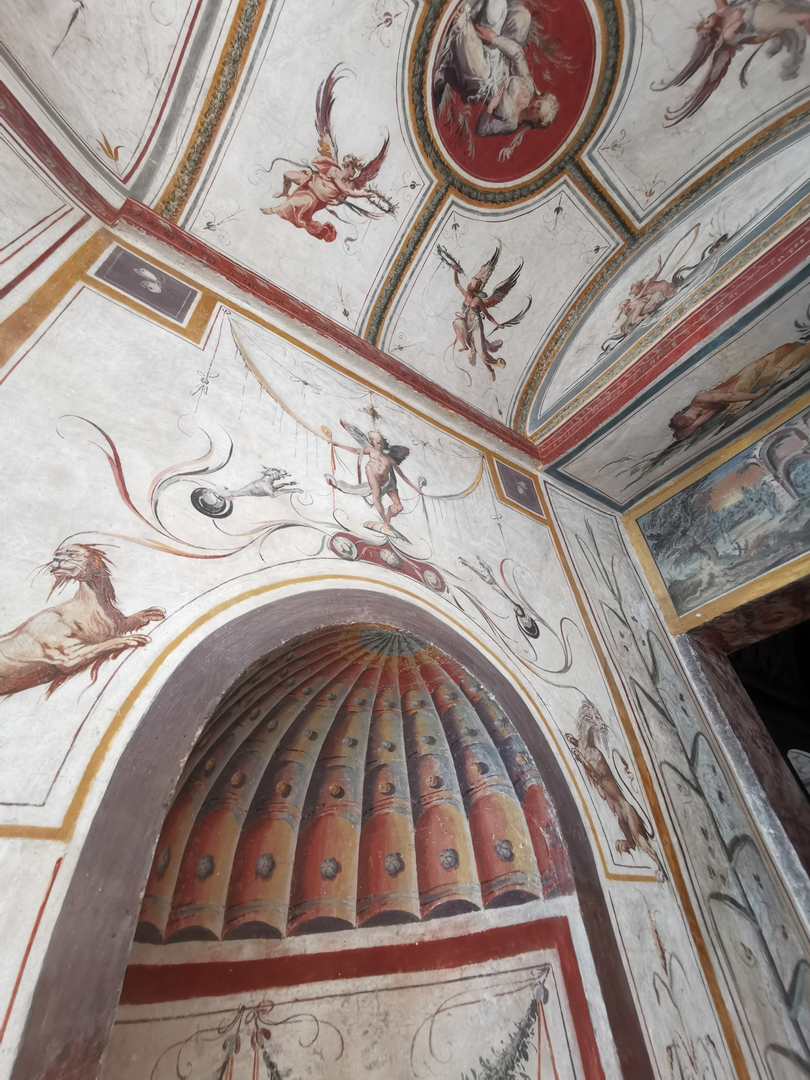
The hall is called “of the Bacchanal” or “of the Putti,” for the subjects depicted in the upper register where, surrounded by a frieze with musical putti and a Bacchic procession, dancing Maenads unfold, a satyr attempting to abduct a nymph while another pours wine to some cherubs, and the Chariot of Bacchus; the adopted theme suggests this room was destined as a banquet hall. The median wall decoration is instead articulated in niches where pagan deities are depicted alternating with panels, according to a common typology derived from the Pauline Hall of Castel Sant’Angelo in Rome.
LITTLE ROOM OF MOSES
The small hall, frescoed both on the walls and on the vault, is called “Little Room of Moses” from the biblical subjects represented on the walls namely: the Miracle of the fall of manna and quails, Moses making water gush from the rock, and the Return of the explorers from the Promised Land. It is the only room in the palace with a religious theme and probably functioned as Cardinal Crispo’s study.
HALL OF JUDGMENTS
The hall, located on the second floor of the palace building called “the Torrazzo,” is so called because scenes from Roman history (“judgments”) are depicted in monochrome as exempla virtutis for the patron, and niches containing deities linked to the natural world; among the exempla one recognizes the continence of Gaius Fabricius Luscinus consul (282 BC), example of austerity and contempt for wealth for having resisted attempts at corruption by the Samnites and Pyrrhus. The upper register instead presents representations of some Muses and three moments of the myth of Perseus.
FRESCOES OF THE ROMAN ROOM
In the small hall, located on the second floor of the palace building called “the Torrazzo,” episodes from the Stories of Romulus are illustrated and chosen with particular reference to the history of Bolsena, in homage to the tradition according to which in the struggles against the Sabines, Romulus would have been helped by the Bolsena native Galerito Lucumene. On the walls appear grotesque motifs stylistically comparable to those of the Hall of Alexander the Great. These latter decorations present stylistic similarities with the Roman interventions of Luzio Luzi for the “Cagliostra” of Castel Sant’Angelo and for the frieze of the Hall of the Eagles in the Palazzo dei Conservatori, and therefore their execution is assigned to the hand of the Roman master in collaboration with Prospero Fontana.
After the death of Tiberio Crispo, the palace was acquired by the Spada Veralli Potenziani family and during the 19th century went through a long period of abandonment. In 1894, with the marriage between Ferdinando del Drago and Maria Angelica Spada Veralli, the palace definitively passed into the hands of the del Drago princes. With the bombings of World War II, the palace suffered further damage, but starting from the mid-1940s, important restoration works began, first with Rodolfo del Drago (1900-1946), then with Giovanni del Drago (1933-2016), and finally Prince Ferdinando Fieschi Ravaschieri del Drago (1978), the current owner.
Information, hours, and images
https://www.palazzodeldrago.it/